
 Back to our convictions
18 December - Gold
Gold: All that glisters?
Safe haven, inflation hedge, diversifier, or conviction asset – what role does gold play today?



Precious metals, and gold in particular, have delivered a remarkable performance over the past three years, accelerating in 2025 with a year-to-date price increase for gold of more than 60% through 11 December. This exceptional momentum raises several questions for investors: should they continue to increase an exposure in an asset that has risen so far, and so fast? What catalysts could prolong the trend? And what role should gold play within a diversified portfolio?
Protection or speculation?
The rise of the yellow metal can no longer be interpreted as a simple hedging move. While still fulfilling its traditional role as insurance against the breakdown of equity–bond correlations and a more uncertain geopolitical backdrop, gold is gradually establishing itself as a genuine allocation choice. Several structural dynamics explain this transformation.
- Central bank reallocations from dollars to gold are providing presumably lasting support, a development that is only weakly sensitive to price. The People’s Bank of China, for example, officially holds only 7.7% of its reserves in gold: a convergence toward the roughly 20% observed in the G10 would imply nearly 3,300 tonnes of additional purchases, equivalent to several years of accumulation (Bloomberg).
- The macroeconomic environment has changed profoundly. Persistently low real rates, expansionary fiscal policies and growing questions about the sustainability of public debt all strengthen the case for holding an asset that is independent of any sovereign entity. Gold is becoming a conviction asset and a natural balancing element in portfolios.
- The broadening of investment access channels has amplified these dynamics. The rise of ETFs in particular has allowed a wider investor base -– retail, private wealth, and institutional –- to gain easy exposure to the metal. In 2025, flows into gold ETFs totalled nearly 750 tonnes, demonstrating this growing adoption (UBS).
We conclude that recent moves are less reflective of speculation than a structural reallocation toward an asset that has become a strategic pillar. Today, gold combines two essential functions: a shock absorber in periods of stress, and a diversification engine in unstable markets.
Gold versus other diversifiers
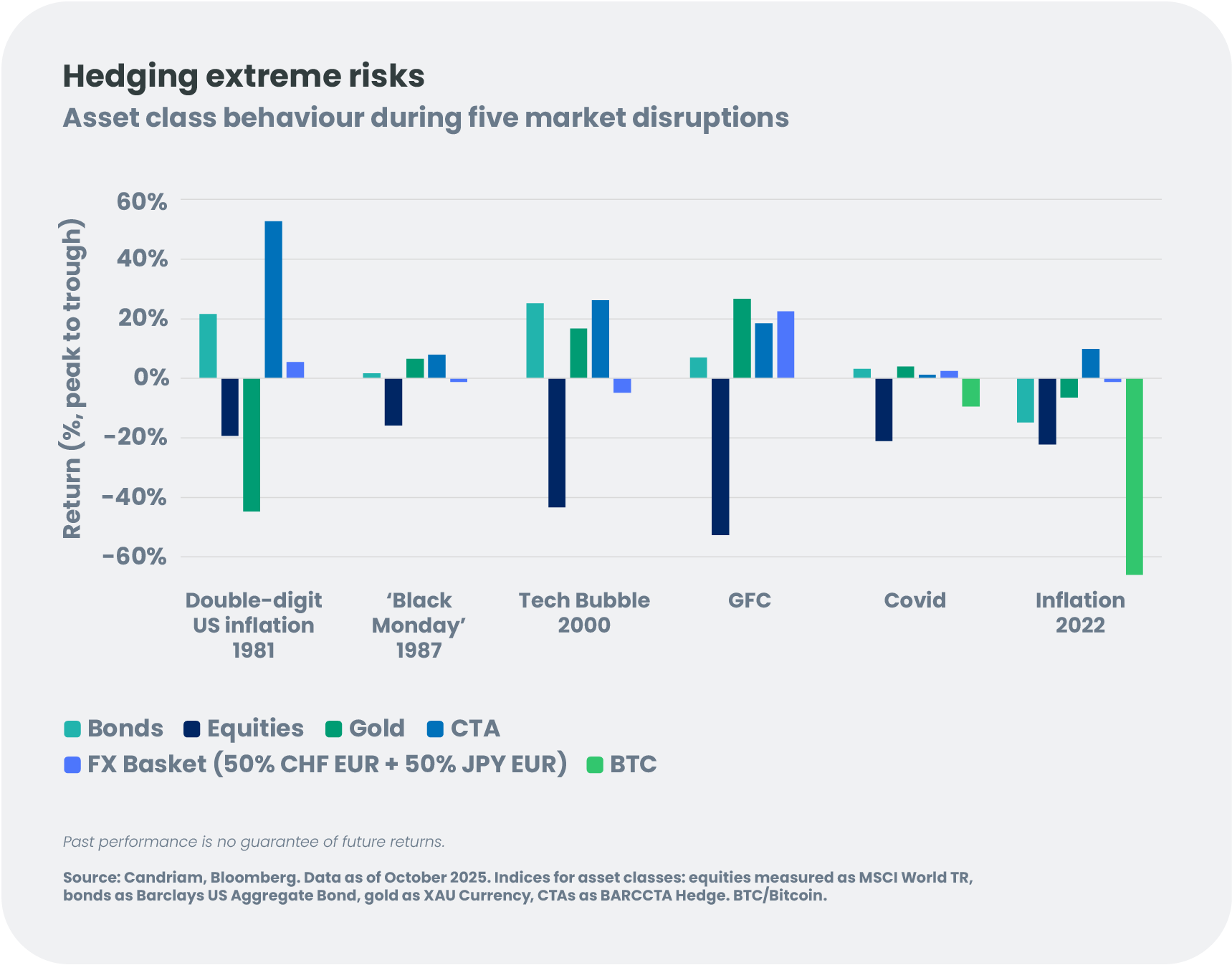
Assets traditionally viewed as safe havens have followed mixed trajectories. Long a natural shock absorber, sovereign bonds have seen their diversifying power diminish with the return of inflation and persistent geopolitical tensions. The US dollar retains a central role, but the persistent fiscal deficit path in the United States and the gradual diversification of investors away from the dollar continue to weaken its stability. The Swiss franc and yen remain fallback currencies, but their effectiveness as diversifiers depends heavily on domestic monetary policy choices.
Bitcoin, sometimes called ‘digital gold’, benefits from its finite supply but remains above all an opportunistic asset, strongly dependent on liquidity conditions. CTA[1] strategies, for their part, can provide useful diversification, particularly in directional phases or during extreme shocks.
In this fragmented landscape, gold stands out as one of the few assets that offers independence from sovereign risk, resilience in periods of recession, and a potential attractive risk–return profile.
How should investors protect portfolios in 2026?
These factors -– structural support, weakening of traditional hedges, increased need for diversification -– feed directly into quantitative analysis.
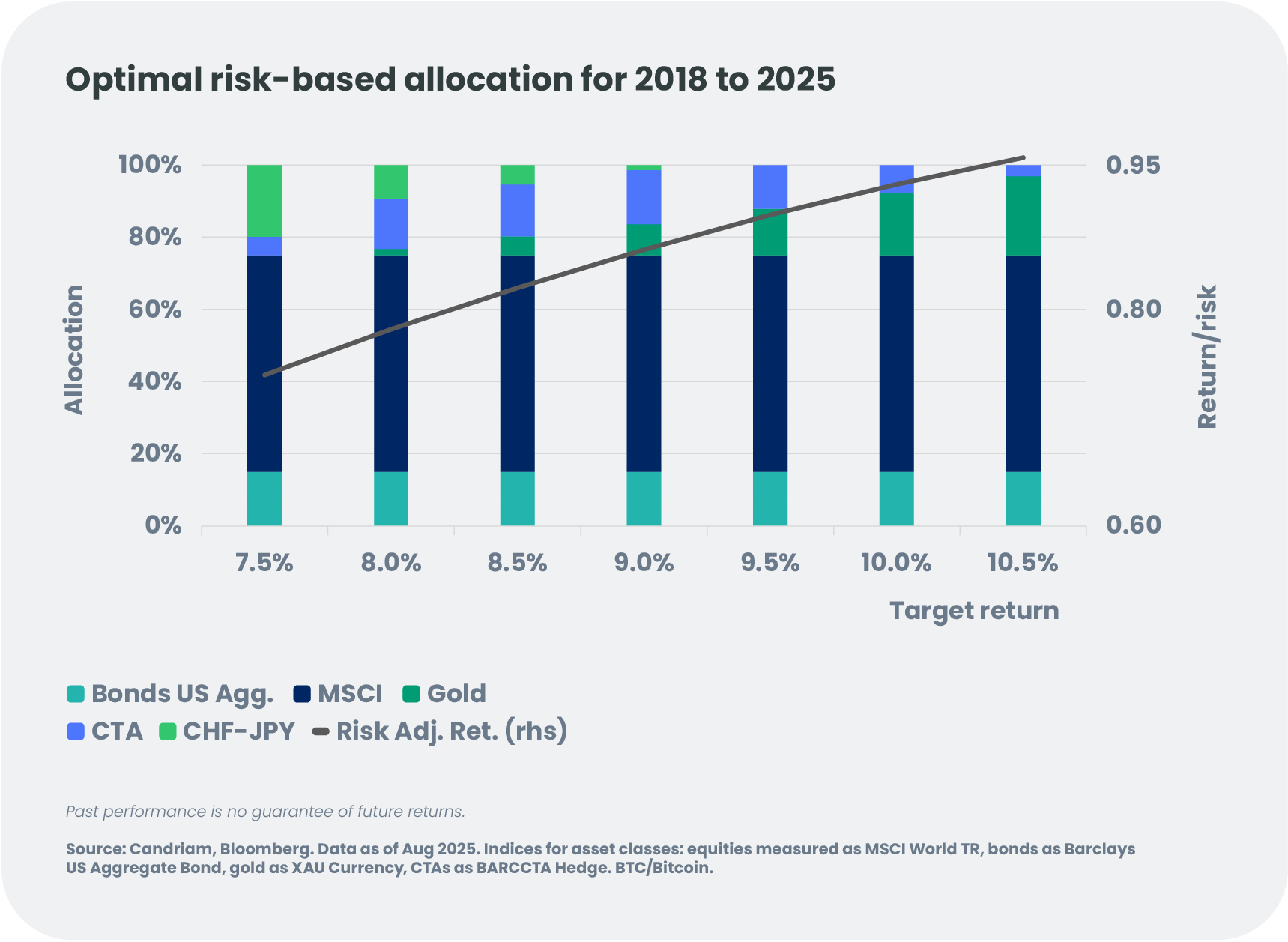
We examined two periods, a stable market regime from 1995 to 2017, and a period including more market disruptions from 2018 through 2025. We used a proprietary optimisation model to determine what in hindsight would have been the most desirable asset allocations under several different risk and return preference levels.
We forced the optimiser to allocate a minimum allocation of 60% of the portfolio to equities, and a minimum of 15% to bonds. This limited the potential ‘best’ portfolios to ones that might reasonably have been created at the time. The stability of the core portfolio therefore reflects these constraints rather than any spontaneous preference of the model. The key lessons lie in the alternatives bucket, the only component that can be adjusted to optimise the risk–return trade-off. Although the optimiser was allowed to increase equities to 100% and bonds to as much as 40% of the portfolio, the model never found that an overweight of traditional assets provided the best risk-reward outcome. This illustrates that marginal value-added over both types of markets was generated exclusively by alternatives.
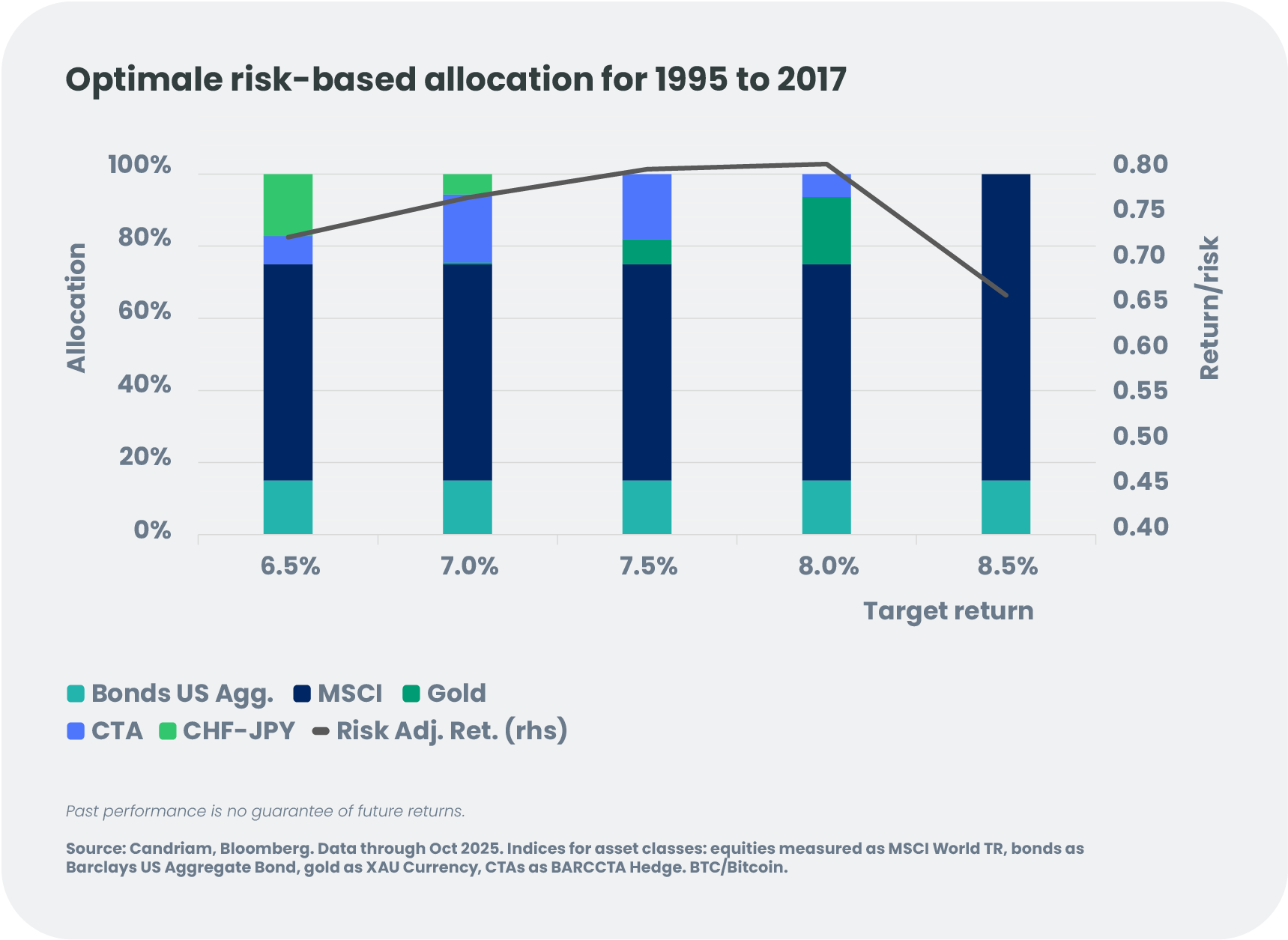
Between 1995 and 2017, a period of generally negative equity–bond correlation and positive real rates, gold already appeared in optimal portfolios, but in an opportunistic way. CTAs complemented diversification, while safe-haven currencies remained secondary.
Since 2018, the change in the macroeconomic regime has led optimised portfolios to make more frequent use of the alternatives bucket. Gold has taken on a growing role, with optimal allocations reaching more than 20% depending on performance objectives, attesting to its increased contribution to the risk–return profile. CTAs complement this block, while the role of safe-haven currencies is waning.
Gold has begun to perform not as a tactical asset, but as a structural component of risk-adjusted performance in an environment where traditional diversification has become less reliable.
The renaissance for gold?
A gold revival appears underway: from a peripheral asset, data shows gold is becoming a strategic component of long-term allocations. Structural drivers including central bank purchases, macro instability and increased investment accessibility continue to enhance its appeal, while the limits of the equity–bond ‘duo’ are narrowing.
Optimisation exercises support this view: when performance targets are modest, the equity–bond combination is sufficient to reach the objective given the portfolio constraints, and the alternatives bucket remains naturally underused. Conversely, as higher returns are targeted, the gradual integration of gold and CTAs becomes essential to improve the risk–return profile.
The issue for 2026 is not whether to hold gold, but in what proportion to integrate it on a lasting basis – and, more broadly, to make use of other precious metals – as a defensive anchor and strategic component in a portfolio designed to navigate a more uncertain future.